
Table of Contents
- Why High Intensity Training Demands Different Gear
- Best Cross-Training Shoes for HIIT: What Actually Holds Up
- HIIT Shoe Features for Stability That Prevent Injury
- The Difference Between Running and HIIT Shoes
- Durability and Wear Patterns: When to Replace Your Training Shoes
- Budget-Conscious Alternatives Without Sacrificing Performance
- How to Choose the Right High Intensity Training Gear
- Frequently Asked Questions
Last Updated: September 21, 2026
Why High Intensity Training Demands Different Gear
Your shoes are the only piece of equipment in constant contact with the floor during every rep, jump, and cut. When you're hunting for a Nike alternative for high intensity training, you're really hunting for footwear engineered around that reality. Krush Khaos built its whole identity around athletes who train through chaos, and the gear that carries you through a session has to survive the same punishment your mindset does.
Best Cross-Training Shoes for HIIT: What Actually Holds Up
The best cross-training shoes for HIIT balance three things: lateral stability, impact absorption, and a fit that locks your foot down. Get those right and the shoe disappears under you. Get them wrong and you feel every landing.
Stability and Lateral Support
Lateral stability comes from a wide, flat outsole and a firm heel counter. Running shoes taper narrow at the midfoot, which is fine for straight-line strides but unstable during side shuffles and skater jumps. A cross-training shoe keeps a broad base under your foot so your ankle doesn't roll when you cut.
Cushioning and Impact Absorption
Cushioning does two jobs: it absorbs landing forces and returns some energy on the next jump. Too soft and you sink, losing power and stability. Too firm and shock travels straight up your shins.
| Feature | Running Shoe | Cross-Training Shoe |
|---|---|---|
| Outsole shape | Narrow, tapered | Wide, flat |
| Primary motion | Forward | Multi-directional |
| Lateral support | Minimal | Reinforced |
| Best for | Distance running | HIIT, lifting, plyometrics |
HIIT Shoe Features for Stability That Prevent Injury
Biomechanical injury prevention starts with shoe selection, not stretching. Most training injuries trace back to instability, poor shock attenuation, or a shoe that lets the foot slide inside it during explosive movement. Before you blame your mobility, check your footwear.
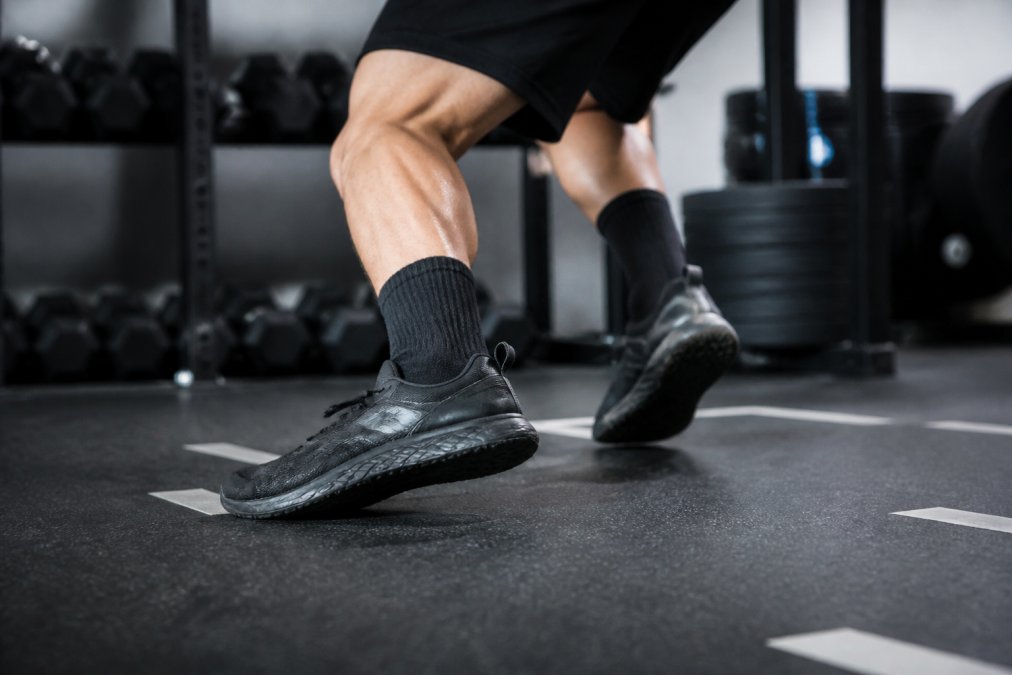
How Specific Shoe Failures Cause Specific HIIT Injuries
Most guides stop at "look for stability." That's useless if you don't know which failure produces which injury. Here's the mechanism chain for the four most common HIIT problems.
The Features That Actually Do the Work
- Lockdown fit: A snug midfoot and secure lacing system stop the foot from sliding during cuts. A foot that slides inside the shoe can't rely on the shoe's stability features at all, because the shoe isn't where the force is going.
- Reinforced heel counter: A rigid heel cup controls rearfoot motion during landings and reduces the inversion range your ankle has to manage.
- Grippy outsole traction: Rubber compound with a herringbone or multi-directional tread pattern grips on gym floors. Slipping mid-cut is a stability failure even if the shoe itself is stable.
- Forefoot flexibility: Enough flex to let your toes push off without folding the shoe. This is the counterweight to midfoot stiffness.
- Arch support matched to your foot strike: Neutral or stability options, depending on how you land. A stability shoe on a neutral, efficient foot can overcorrect and create its own problems.
The Difference Between Running and HIIT Shoes
Running shoes and HIIT shoes are built for opposite problems. Running shoes prioritize forward momentum and repetitive impact over thousands of strides. HIIT shoes prioritize stability and multi-directional control over short, violent bursts. Wearing one for the other is like using a screwdriver as a pry bar: it works until it snaps.
Durability and Wear Patterns: When to Replace Your Training Shoes
Shoe longevity depends on training intensity, surface, and how the midsole foam degrades over time. Cushioning loses its energy return long before the outsole looks worn, which is why most people keep training in dead shoes without realizing it. The outsole is the last thing to fail, not the first.
Why Midsole Foam Dies Before the Tread Does
EVA and similar foam midsoles work by compressing under load and springing back. Every landing cycles the foam, and over thousands of cycles the cell structure permanently collapses. The foam gets thinner, firmer, and less able to return energy. Visually, the shoe still looks fine. Functionally, it's now transmitting more force into your shins, knees, and hips than it did when new.
Replacement Cadence by Training Volume
There's no universal mileage number for HIIT shoes the way there is for running shoes, because HIIT loads shoes differently: more lateral shear, more impact per minute, less repetitive forward roll. But you can build a working estimate from session volume.
- Casual (2-3 HIIT sessions per week, 30-45 minutes each): Expect roughly 9-12 months from a quality training shoe before the midsole noticeably degrades.
- Regular (4-5 sessions per week, 45-60 minutes each): Expect roughly 5-8 months.
- High volume (5-6 sessions per week, plus lifting or sport practice): Expect roughly 3-5 months, and consider rotating two pairs to stretch both.
- Competitive or multi-sport athletes: Treat shoes as consumables and budget for replacement every 3-4 months, or sooner if you train on abrasive surfaces like outdoor turf or concrete.
Wear Signals, Ranked by What They Actually Mean
Watch for these, in order of how much they should worry you:
- Compressed midsole: Visible creasing or flattening where your foot lands. This is the real failure. If you can press the midsole with your thumb and it barely rebounds, the shoe is done regardless of tread.
- Uneven outsole wear: Heavier wear on one side points to a gait issue worth addressing. It also tells you the shoe is loading asymmetrically, which compounds over time.
- Lost grip: Slick tread on the forefoot, especially noticeable on smooth gym floors. This is a safety issue more than a performance one, because slipping mid-cut is how ankles roll.
- Upper breakdown: Stretched mesh or torn overlays around the flex points. Cosmetic at first, structural once the midfoot cage loosens and lockdown degrades.
The Rotation Strategy
Rotating two pairs extends the life of both and lets foam recover between sessions. Foam that gets 48 hours to rebound before its next load cycle degrades more slowly than foam loaded every day. If you train four or more days a week, that rotation pays for itself, and it also gives you a backup pair when one finally dies mid-training-block instead of forcing a rushed replacement.
Budget-Conscious Alternatives Without Sacrificing Performance
You don't need to spend the most to get a shoe that holds up. The performance gap between mid-tier and top-tier training shoes is smaller than the price gap suggests.
Priorities when shopping on a budget:
- Buy last season's model, which drops in price once the new version lands.
- Skip lifestyle crossovers and buy from the training category directly.
- Check the outsole first. A durable rubber compound matters more than a flashy upper.
- Look for reinforced heel counters and lockdown lacing, the two features that most affect stability.
How to Choose the Right High Intensity Training Gear
Choosing the right gear comes down to matching the shoe to your actual training, not the marketing. Start with your program. Count how much of your week is plyometrics, how much is weightlifting, and how much is conditioning. That split tells you which features matter most.
Then run this quick check:
- Does the outsole stay flat and wide under lateral load?
- Does the heel lock down without pinching the midfoot?
- Does the midsole feel firm, not mushy, under a jump landing?
- Does the upper resist abrasion from ropes and sleds?
- Does the shoe fit your arch and foot strike?
Frequently Asked Questions
What shoes are good for high intensity training?
Cross-training shoes work best for high intensity training because they combine lateral stability, forefoot flexibility, and enough cushioning for jumps. Look for a firm heel for weightlifting, a grippy rubber outsole for multi-directional movement, and a snug lockdown fit. Running shoes lack the side-to-side support HIIT demands, so they increase roll risk during plyometrics and lateral drills.
Do I need specific shoes for HIIT or can I use running shoes?
You can use running shoes for short HIIT sessions, but they are not ideal. Running shoes have a higher heel-to-toe drop and softer midsoles designed for forward motion, not lateral cuts or weightlifting. For regular high intensity training, a cross-training shoe with torsional rigidity and a stable heel gives you better control, reduces ankle roll risk, and holds up longer under mixed training loads.
How do I know when my training shoes need replacing?
Check the midsole for compression lines and the outsole for worn tread patterns, especially at the forefoot and heel. If the shoe feels flat or you notice new foot or knee soreness after sessions, the cushioning has likely broken down. Most cross-training shoes last 300 to 500 training hours depending on surface, body weight, and how often you rotate them.
Are cross-training shoes better than running shoes for HIIT?
For the difference between running and HIIT shoes, cross-trainers win for high intensity training. They offer lateral stability, a firmer heel for weightlifting, and forefoot flexibility for plyometrics. Running shoes prioritize forward cushioning and energy return, which helps distance running but leaves you unstable during side shuffles, box jumps, and functional fitness circuits that demand multi-directional movement.
Finding gear that survives high intensity training isn't about chasing the biggest logo. It's about matching footwear and apparel to the way you actually move, then replacing it before it fails you. Krush Khaos builds gear for athletes, dreamers, and underdogs who refuse to be defined by setbacks, with apparel designed to embrace the chaos of hard training. Shop now and wear your dedication with gear built for those who turn doubt into fuel.