
Table of Contents
- What You'll Need Before You Start Shopping for Athletic Gear
- Step 1: Match Athletic Gear to Your Injury Type
- Step 2: Choose the Best Compression Gear for Injury Recovery
- Step 3: Build Supportive Footwear and Bracing Into Your Routine
- Step 4: Learn How to Prevent Chafing During Long Distance Running
- Step 5: Use Mental Recovery Strategies for Injured Athletes
- Common Mistakes to Avoid With Athletic Gear During Recovery
- Frequently Asked Questions
Last Updated: September 20, 2026
What You'll Need Before You Start Shopping for Athletic Gear
Athletic gear for overcoming sports injuries is equipment and apparel chosen to protect a healing body while you rebuild strength. The right gear supports recovery instead of delaying it. Krush Khaos built its whole brand around that mindset: pressure is fuel, not a stop sign.
Before you buy anything, gather four things:
- A clear diagnosis from a doctor or physical therapist
- A written list of movements you must avoid
- Your return-to-sport timeline
- A budget that covers the whole recovery, not just week one
Step 1: Match Athletic Gear to Your Injury Type
Gear that fits a sprained ankle will do nothing for an inflamed tendon. Match the tool to the tissue. Here's how the two main categories break down.
Sprains, Strains, and Soft Tissue Injuries
Sprains and strains damage ligaments and muscles. These injuries need joint stabilization and protection during the early recovery phase. Braces, wraps, and compression sleeves do the heavy lifting here.
Look for gear that:
- Limits side-to-side motion without locking the joint
- Breathes so swelling doesn't trap heat
- Fits snug but never cuts off circulation
Tendinitis, Bursitis, and Overuse Injuries
Tendinitis and bursitis build up over time. They respond to load management, not immobilization. The gear here is about reducing strain while you keep moving.
- Counterforce straps take pressure off the tendon
- Sleeves keep the area warm and improve proprioception
- Resistance bands let you load the tissue at low intensity
Step 2: Choose the Best Compression Gear for Injury Recovery
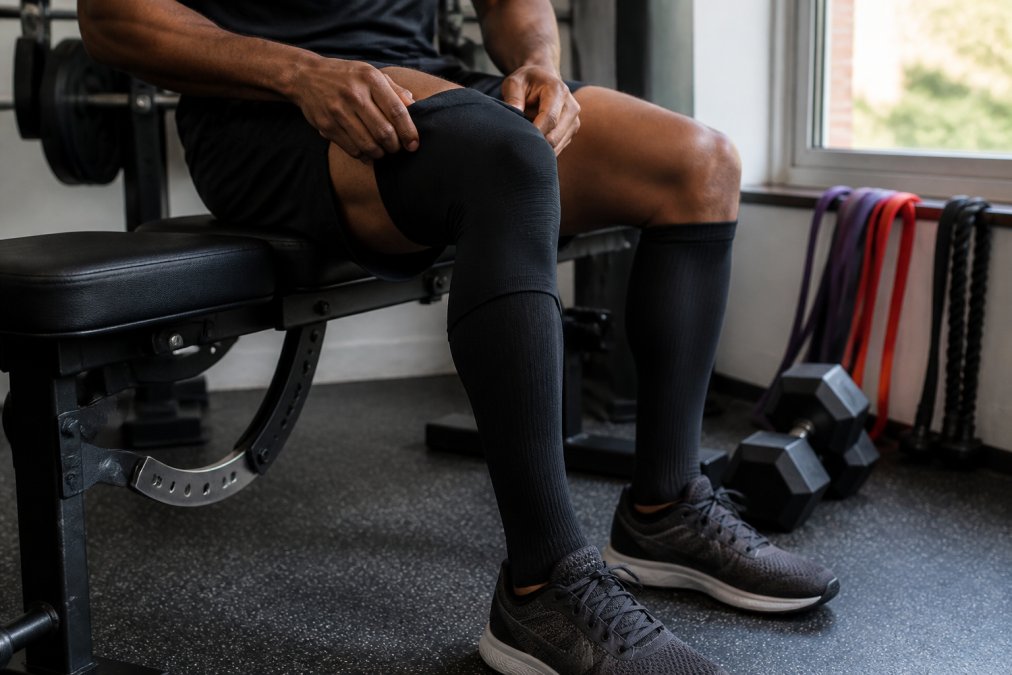
The best compression gear for injury recovery delivers even pressure across the injured area without pinching or rolling. Compression therapy reduces swelling and supports joint stabilization during the recovery phase.
| Compression Level | Best For | Wear Time |
|---|---|---|
| Mild | Swelling, light support | All day |
| Moderate | Sprains, post-workout | During activity |
| Firm | Serious strains, clinician-guided | As directed |
Step 3: Build Supportive Footwear and Bracing Into Your Routine
Supportive footwear absorbs impact and corrects how your foot lands. That matters because the kinematic chain runs from your feet to your hips. Fix the base and the rest follows.
Start with these steps:
- Get your gait checked by a physical therapist
- Pick shoes built for your sport and your foot shape
- Add orthotic support if you overpronate
- Replace worn shoes every 300 to 500 miles of running
- Rotate two pairs to let foam recover
Step 4: Learn How to Prevent Chafing During Long Distance Running
To prevent chafing during long distance running, remove friction before it starts. Chafing comes from skin rubbing against skin or fabric, made worse by sweat and salt.
Do this:
- Wear seamless, moisture-wicking apparel
- Apply anti-chafe balm to thighs, nipples, and underarms
- Avoid cotton entirely
- Test new gear on short runs first
- Reapply balm on runs over 90 minutes
Step 5: Use Mental Recovery Strategies for Injured Athletes
Mental recovery strategies for injured athletes matter as much as the physical ones. Injury sidelines your identity, not just your body. That gap causes most of the frustration. But here is the angle most recovery guides skip: your gear is a psychological tool, not just a physical one. How and when you use it shapes whether you feel like an athlete in rehab or a patient waiting to be cleared.
Why Gear Choice Affects Recovery Mindset
A brace you wear all day signals "broken." A compression sleeve you put on only for your rehab session signals "training." Same tissue, different identity. Most practitioners find that athletes who keep a defined "training window", a set time each day when they put on their gear and do their protocol, report better adherence than athletes who wear support gear passively around the clock.
A Weekly Mental Recovery Protocol Tied to Your Gear
Try this structure, adjusting the specifics to your clinician's plan:
- Set one non-sport goal per week. Example: complete every scheduled band session, not "get back to sprinting." Gear-based goals are measurable and within your control.
- Keep a gear log, not just a pain log. Note which brace, sleeve, or strap you used, for how long, and how the joint felt afterward. Patterns emerge fast, often within two to three weeks.
- Visualize the return-to-sport milestone, then reverse-engineer it. If your goal is a full practice in eight weeks, what gear do you need to be out of by week six? What gear do you still need at week seven? Write it down.
- Stay connected to your team or training group. Show up to practices in your recovery gear if your clinician allows it. Proximity to the group preserves identity better than phone check-ins.
- Talk to a sports psychologist if mood drops for more than two weeks. Persistent low mood after injury is common and treatable. It is not a toughness problem.
The Gear Taper as a Mental Milestone
Tapering off a brace or sleeve is a psychological event, not just a physical one. Plan it deliberately. A common pattern is to reduce wear time by roughly one session per week under clinician guidance, rather than quitting cold. Each step down is a visible win you can log.
Common Mistakes to Avoid With Athletic Gear During Recovery
The biggest gear mistakes during recovery all share one root: rushing. But the most damaging mistake is one almost no recovery guide covers, using gear past the point where it still works. Worn-out support does not just underperform; it can quietly cause the recurring injury you are trying to avoid.
The Gear Maintenance and Replacement Gap
Most athletes replace gear when it looks bad. That is too late. Structural failure happens before visible wear. Here is what to inspect and when to replace:
- Compression sleeves and socks. Elasticity is the whole product. A common pattern is that sleeves lose meaningful compression after roughly six months of regular use, or sooner with frequent hot-water washing. Test: stretch the cuff and see if it snaps back within a second. If it sags, replace it.
- Braces with hinges or straps. Check hinge screws monthly. Check strap hook-and-loop (Velcro) closure, once it stops gripping firmly, the brace cannot hold its position, and a sliding brace provides no support.
- Running and court shoes. Foam loses rebound long before the outsole wears through. Replace every 300 to 500 miles of running, or every four to six months for regular court or field sport. Rotate two pairs to let foam recover between sessions.
- Orthotics and insoles. Replace every six to twelve months, or sooner if the arch support flattens or the top layer compresses.
- Resistance bands. Inspect for nicks, discoloration, and chalky texture. A band that snaps mid-rep can cause a fall or a sudden load spike. Replace at the first sign of wear.
How to Track Replacement Dates
Put every piece of recovery gear into your phone with a purchase date and a replacement reminder. Set the reminder at 80 percent of the expected life so you have time to shop before the gear fails. This one habit prevents more recurring injuries than any single brace purchase.
The Other Mistakes That Still Matter
- Wearing a brace past the healing phase. It weakens the muscles you need back. Taper under clinician guidance.
- Skipping the fit check. Loose compression does nothing. Measure the limb, then check the sizing chart.
- Buying gear for the injury you had, not the one you have. Reassess at every phase change.
- Washing compression gear in hot water or the dryer. Hand wash in cool water and air dry. Heat kills elasticity.
Budget-Friendly Alternatives That Still Work
You do not need clinical-grade gear to recover well. Resistance bands and a foam roller cost little and cover most rehabilitation exercises at home. A basic neoprene sleeve handles mild swelling. A counterforce strap handles most tendon irritation. Spend on the items your clinician says are load-bearing for your specific injury, and go basic on the rest.
Frequently Asked Questions
How does compression gear help with injury recovery?
Compression gear applies graduated pressure to limbs, which supports venous return and reduces swelling during the recovery phase. It also improves proprioception, so your joints feel more stable while you rebuild range of motion. For sprains and strains, wearing compression sleeves or tights during rehabilitation exercises can reduce muscle fatigue and help you return to sport with more confidence. Fit matters more than brand: too loose and it does nothing, too tight and it restricts blood flow.
What should I look for in supportive athletic apparel during rehab?
Look for four things: flatlock seams to prevent chafing, four-way stretch so the fabric moves with your joint stabilization work, moisture-wicking material to keep skin dry, and a snug but not restrictive fit. For lower-body injuries, consider tights with targeted compression zones. For upper-body issues, supportive tops with compression panels help with posture and shoulder stability. Krush Khaos apparel is built for athletes who train through adversity, so durability and comfort hold up during long rehab sessions.
How do I prevent chafing during long distance running while recovering from an injury?
Apply anti-chafe balm to high-friction areas before every run, wear seamless moisture-wicking apparel, and avoid cotton. If you are returning from a soft tissue injury, compression shorts or tights reduce skin movement and keep fabric from bunching. Test new gear on short runs first. Replace worn apparel when seams start to fray, because rough edges cause chafing even on short distances.
What mental recovery strategies help injured athletes stay motivated?
Set process goals instead of outcome goals. Instead of 'run a personal best in eight weeks,' aim for 'complete three rehab sessions this week.' Keep a training log that tracks small wins. Visualize your return to sport in specific detail. Stay connected to your team or training group even when you cannot participate fully. Resilience training is not just physical; the athletes who recover best treat mindset work as part of the program, not an afterthought.
Recovery tests your patience more than your body. The right gear shortens that test. Krush Khaos builds apparel for athletes who refuse to be defined by a setback, with sweat-wicking fabrics and flat seams that hold up through intense training. Shop now and wear your comeback.