
Table of Contents
- Build Your Support Network and Daily Routine
- How to Set Rehab Goals That Keep You Moving Forward
- Psychological Recovery From Sports Injury: Rebuilding Your Mindset
- Returning to Sport After Injury Anxiety: Building Confidence Back
- Track Progress and Celebrate Milestones
- Nutrition and Sleep: The Recovery Habits Most Athletes Skip
- Conclusion: Turn Doubt Into Fuel
- Frequently Asked Questions
Last Updated: September 14, 2026
Build Your Support Network and Daily Routine
Recovering from a sports injury is as much a mental challenge as a physical one, and learning to stay motivated is central to both. According to the American College of Sports Medicine, athletes who maintain structured routines and strong support systems report better adherence to rehabilitation protocols. The right mindset and the right people around you can turn a setback into a comeback.
The first step in learning how to stay motivated after sports injury is accepting that you cannot do it alone. Isolation breeds frustration. But "build a support network" is useless advice unless you know who to recruit and what to ask them for. A working network has four distinct roles, and most athletes only fill one or two of them:
- The clinician (physical therapist or athletic trainer): owns the plan, sets the loading progression, and is the only person who should clear you for new activity. Do not let a coach or teammate override this role.
- The accountability partner: one person who texts you the same question every day, "Did you do your rehab?" A teammate, sibling, or training partner works. The key is that it is the same person, every day, so the question becomes a ritual rather than a nag.
- The identity anchor: someone who knew you before the injury and treats you the same now. This is the person who keeps you from collapsing your entire self-concept into "injured athlete."
- The pressure valve: someone you can complain to without consequence, a friend outside your sport, a counselor, or a sports psychologist. Venting to your physical therapist wastes session time; venting to your accountability partner undermines the ritual. Give frustration its own dedicated outlet.
A practical way to build this: in the first week after injury, send four short messages. One to your PT asking what they need from you between sessions. One to your accountability partner asking if they will check in daily for the next 30 days. One to your identity anchor saying you need to talk about something other than rehab. One to your pressure valve saying you will probably need to vent. Four texts, four roles filled.
A practical daily recovery routine:
Structure matters because when your training schedule disappears, your sense of purpose can vanish with it. But the routine should shift with your healing phase, not stay static:
- Protection phase (typically the first days to weeks): Morning mobility work exactly as prescribed by your physical therapist; midday pain and swelling log; afternoon rest or gentle range-of-motion work; evening check-in with your accountability partner.
- Repair phase (once cleared for loading): Morning mobility; midday strength session within your PT's parameters; afternoon low-impact cardio if cleared (stationary bike, pool work); evening review of tomorrow's targets.
- Return phase (cleared for sport-specific work): Morning mobility; midday sport-specific drills at sub-maximal intensity; afternoon recovery work (soft tissue, mobility); evening confidence journal entry, one line about what your body handled well today.
One more thing most articles skip: your support network needs maintenance too. Athletes who lean hard on a partner or parent for months often burn that relationship out. Rotate the load. If your accountability partner has checked in for 30 straight days, thank them and ask if they want to keep going or hand the role to someone else. A network you exhaust is not a network.
How to Set Rehab Goals That Keep You Moving Forward
Effective rehab goals are specific, measurable, and short-term. Instead of "get back to full strength," aim for "complete 3 sets of 10 leg extensions without pain by Friday." Small wins build momentum.
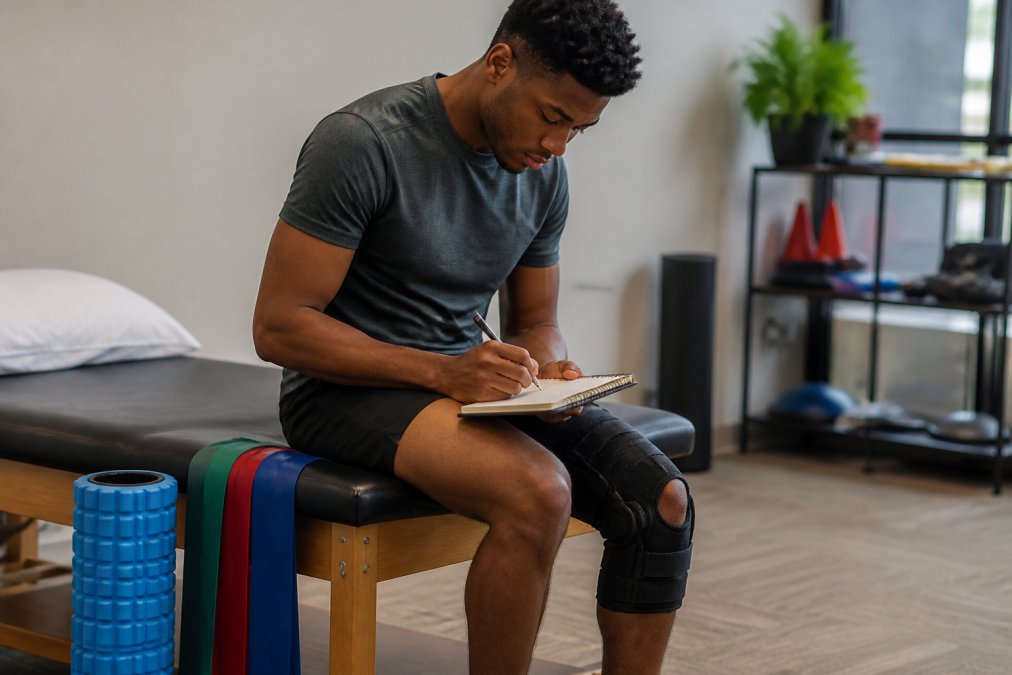
When you learn how to set rehab goals properly, you give yourself a reason to show up each day. Physical therapists often recommend breaking long-term recovery into weekly milestones. This approach keeps motivation high because you are always chasing a target you can actually hit.
Here is a simple goal-setting framework:
| Timeframe | Goal Type | Example |
|---|---|---|
| Daily | Micro-goal | Complete 15 minutes of prescribed stretching |
| Weekly | Milestone | Walk 10 minutes without a limp |
| Monthly | Progress marker | Return to light jogging |
| Season | Long-term goal | Full return to competition |
Psychological Recovery From Sports Injury: Rebuilding Your Mindset
Psychological recovery from sports injury is the process of rebuilding your mental resilience, confidence, and sense of identity after physical trauma. It is just as important as tissue repair.
Many athletes underestimate this part. Your body may heal, but fear and doubt can linger. Research from the American Psychological Association highlights that psychological support significantly improves rehabilitation outcomes for injured athletes.
Managing Frustration and Kinesiophobia
Frustration is normal. So is kinesiophobia, the fear of movement that follows an injury. Left unchecked, it slows recovery and erodes confidence.
Strategies that help:
- Name the emotion. Saying "I am frustrated" reduces its grip.
- Focus on what you can control: effort, attitude, and adherence to your plan.
- Use positive reinforcement. Reward yourself for showing up, not just for results.
- Talk to a sports psychologist or counselor if fear of re-injury persists.
Returning to Sport After Injury Anxiety: Building Confidence Back
Returning to sport after injury anxiety is the apprehension athletes feel about re-injuring themselves or underperforming when they return to competition. It is one of the most common hurdles in long-term recovery.
The fix is gradual exposure. Start with low-risk drills and build up. Each successful session is evidence that your body can handle more.
Track Progress and Celebrate Milestones
Progress tracking turns vague hope into visible proof. But "keep a log" is where most articles stop, and it is why most athletes quit logging by week two. The fix is tracking the right three metrics, and understanding that the numbers are not just for motivation. They are the evidence you will use later to talk yourself out of re-injury fear.
Track these three things, nothing more:
- Pain-free range of motion or load. Not "how much pain do I have" but "what can I do without pain today?" Example: "Leg extension, 3 sets of 10 at 40 pounds, no pain." This is the number that moves when you are actually healing.
- Adherence rate. Did you complete the prescribed sessions this week? A simple tally, 6 of 7 days, is enough. Adherence is the one variable you fully control, which makes it the right thing to reward yourself for.
- Confidence rating. Once a week, rate your confidence in returning to your sport on a 1-10 scale. This is the metric almost nobody tracks, and it is the one that predicts whether you will actually come back or quietly fade out.
Why the confidence rating matters: kinesiophobia.
Kinesiophobia, the fear of movement after injury, is one of the most common reasons athletes never return to their prior level, even after tissue has healed. It does not show up on an MRI. It shows up as hesitation, as skipping the drill you are cleared for, as "I'll start next week." A weekly confidence number makes it visible. If your pain-free load is climbing but your confidence rating is flat or falling, that is a signal to bring up fear of re-injury with your physical therapist or a sports psychologist, not to push harder in the gym.
How to use the log against fear.
When you are cleared for a drill and your gut says not yet, open the log. You are not looking for a feeling. You are looking for evidence: "I have done this movement 14 times in the last two weeks without pain." That is the counter-argument to kinesiophobia, and it only exists if you wrote it down.
Celebrate milestones by category, not by size.
Small wins build momentum, but "celebrate everything" dilutes the signal. Group your milestones so each one means something specific:
- Range milestones: first full range of motion, first pain-free stretch.
- Load milestones: first bodyweight movement, first added resistance, first session at pre-injury weight.
- Function milestones: first pain-free step, first walk without a limp, first stair climb without compensation.
- Sport milestones: first jog, first cut, first full-speed drill, first scrimmage.
Mark each one in the log with the date. When motivation dips, and it will, usually around weeks three to six when the novelty is gone and the finish line still looks far away, the log is the only thing that can show you the slope you have already climbed.
Nutrition and Sleep: The Recovery Habits Most Athletes Skip
Two habits separate fast healers from slow ones: nutrition and sleep. Most athletes overlook both.
Nutrition for injury recovery means prioritizing protein, vitamin D, calcium, and omega-3s. These support tissue repair and reduce inflammation. Skip the processed food and alcohol, which slow healing.
Sleep hygiene during recovery is equally critical. Aim for 7-9 hours per night. Your body releases growth hormone during deep sleep, which drives tissue repair. A dark, cool room and a consistent bedtime make a measurable difference.
According to the National Sleep Foundation, athletes who sleep less than 7 hours are significantly more likely to suffer re-injury.
Conclusion: Turn Doubt Into Fuel
Recovery tests you in ways competition never does. The frustration, the doubt, the slow days: they are all part of the process. What separates athletes who come back stronger from those who fade is mindset.
Krush Khaos exists for the underdogs, the ones who refuse to be defined by a setback. Our Turn Doubt Into Fuel Tee ($44.99), Silent Work Hoodie ($59.99), and Discipline Outworks Talent Hoodie ($59.99) are built for athletes who treat every challenge as fuel. You do not need to be at full strength to wear your dedication.

Get started with Krush Khaos and turn your recovery into the foundation for your next comeback.
Frequently Asked Questions
How do you stay positive when you can't train?
Shift your focus to what you can control: physical therapy sessions, sleep quality, nutrition, and mental rehearsal. Set short-term goals like completing three rehab exercises daily or improving range of motion by a few degrees. Visualization of your return to sport keeps your motivation anchored. Staying connected to your team or training partners also protects your athlete identity while your body heals.
What are effective goal-setting strategies for injured athletes?
Use a tiered approach: daily process goals (complete prescribed exercises), weekly milestones (pain-free walking or increased range of motion), and long-term return-to-sport targets. Write them down and review weekly. Short-term goals give you wins during the slow weeks of tissue repair, while the long-term goal reminds you why the boring rehab work matters. Adjust goals as your physical therapy team updates your plan.
How to maintain an athlete's identity while recovering?
Your identity is built on discipline and consistency, not just competition. Keep showing up to rehab like you would to practice. Stay around your team, help teammates, study film, or mentor younger athletes. Wear gear that reflects your mindset and reminds you who you are. The habits that made you an athlete do not disappear because of a season-ending injury; they just take a different form during recovery.
What is the role of visualization in injury rehabilitation?
Visualization activates many of the same neural pathways as physical practice, which helps maintain motor patterns and confidence during rehabilitation. Spend 10 to 15 minutes daily imagining successful movements: a clean lift, a pain-free sprint, a confident return to competition. Pair visualization with breathing exercises to reduce kinesiophobia. Research on mental imagery in sports shows it supports both psychological recovery and physical readiness.