
Table of Contents
- HIIT Exercises Without Equipment: The 10-Move List
- HIIT Workout Intervals for Beginners
- Beginner HIIT Workout at Home
- Low-Impact HIIT Workout Without Jumping
- 10-Minute HIIT Workout
- Form, Safety, and When to Scale Back
- Frequently Asked Questions
Last Updated: October 13, 2026
HIIT Exercises Without Equipment: The 10-Move List
High-intensity interval training (HIIT) is a training style that alternates short bursts of hard effort with brief rest periods to spike your heart rate and keep it there. The best part? You can do the 10 best HIIT exercises without equipment right in your living room. This guide from Krush Khaos breaks down each move, how long to work, how long to rest, and how to scale it to your level.
Here's what most people get wrong: they treat HIIT like a longer workout. It isn't. You go harder for less time. That's the whole point.
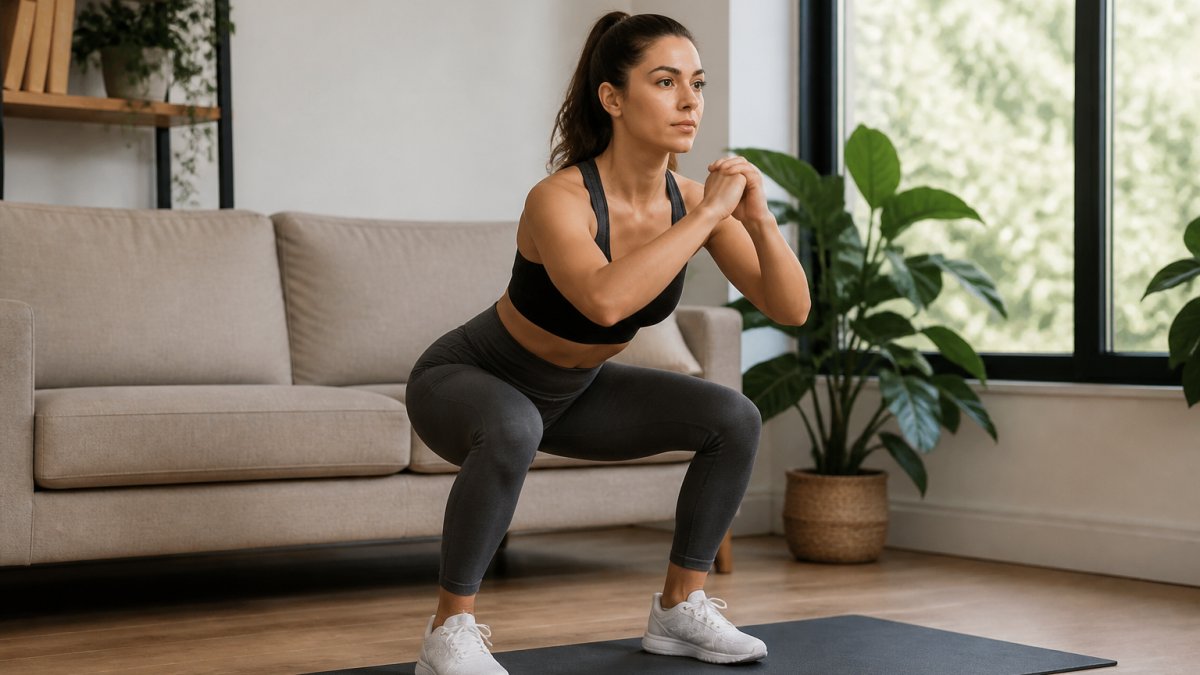
1. Bodyweight Squats
Stand with feet shoulder-width apart. Push your hips back and bend your knees until your thighs are near parallel to the floor. Drive back up through your heels. Work 40 seconds, rest 20 seconds.
2. Push-Ups
Start in a plank with hands under your shoulders. Lower your chest toward the floor, then press back up. Keep your core tight and hips level. Work 40 seconds, rest 20 seconds. Drop to your knees if needed.
3. Reverse Lunges
Step one foot back and lower until both knees bend to about 90 degrees. Push through the front heel to return. Alternate legs. Work 40 seconds, rest 20 seconds.
4. Burpees
Squat down, kick your feet back to a plank, do a push-up, jump your feet in, and leap up. Work 30 seconds, rest 30 seconds. This is the hardest move on the list, so pace yourself.
5. Mountain Climbers
From a plank, drive one knee toward your chest, then switch fast. Keep hips low. Work 40 seconds, rest 20 seconds.
6. Jump Squats
Do a bodyweight squat, then explode upward. Land soft with bent knees. Work 30 seconds, rest 30 seconds. Skip the jump if your knees complain.
7. Plank
Hold a straight line from head to heels on your forearms. Squeeze your core and glutes. Hold 40 seconds, rest 20 seconds.
8. Sit-Ups
Lie on your back, knees bent, feet flat. Curl up toward your knees, then lower with control. Work 40 seconds, rest 20 seconds.
9. Russian Twists
Sit with knees bent and lean back slightly. Rotate your torso side to side, tapping the floor beside each hip. Work 40 seconds, rest 20 seconds.
10. High Knees
Run in place, driving each knee to hip height. Pump your arms. Work 40 seconds, rest 20 seconds.
HIIT Workout Intervals for Beginners
The standard HIIT workout interval for beginners is 40 seconds of work followed by 20 seconds of rest. That 2:1 ratio is a solid starting point for most moves. Harder exercises like burpees and jump squats work better at a 1:1 ratio, so 30 seconds on, 30 seconds off.
Why does this matter? Because going too hard too early is the number one reason beginners quit. Start with 20 seconds of work and 40 seconds of rest if you're brand new. Build up over a few weeks.
Here's a simple way to think about it:
- New to training: 20 seconds work, 40 seconds rest
- Some fitness base: 30 seconds work, 30 seconds rest
- Confident and conditioned: 40 seconds work, 20 seconds rest
The American College of Sports Medicine exercise guidelines recommend building intensity gradually rather than jumping straight into max effort.
Beginner HIIT Workout at Home
A beginner HIIT workout at home needs three things: simple moves, short rounds, and real rest. Skip the complicated choreography. Stick to squats, push-ups, lunges, and planks, and treat the first two weeks as a form-building phase rather than a test of willpower.
Try this starter circuit:
- Bodyweight squats: 20 seconds work, 40 seconds rest
- Push-ups (knees okay): 20 seconds work, 40 seconds rest
- Reverse lunges: 20 seconds work, 40 seconds rest
- Plank: 20 seconds hold, 40 seconds rest
Run through it twice. That's it. Ten minutes, done. Add a round each week as you get stronger.
Beginner Modifications for Each Move
- Squats: If your heels lift or your lower back rounds, squat to a chair or bench and tap it lightly before standing. That teaches the hip-hinge pattern without loading your knees at the bottom.
- Push-ups: Start with hands on a counter or wall. As that gets easy, move to a coffee table, then the floor on your knees, then a full push-up. Each surface change is a real progression, not a shortcut.
- Reverse lunges: Hold a wall or chair for balance. Step back only as far as you can control; a short step with a tall torso beats a long step that wobbles.
- Plank: Drop to your knees or put your forearms on a bench. The goal is a straight line from head to heels, not a long hold with a sagging lower back.
How to Progress Without Burning Out
A common pattern is to add one round per week for three weeks, then add five seconds of work to each interval in week four. Keep the rest period fixed at 40 seconds until the work intervals feel controlled from start to finish. If your form breaks before the timer ends, you added too much too soon. Back off one step and rebuild.
Low-Impact HIIT Workout Without Jumping
A low-impact HIIT workout without jumping keeps the intensity high while sparing your joints. You swap every jump for a controlled version that still spikes your heart rate.
The moves that work best here:
- Squats instead of jump squats
- Step-back lunges instead of jumping lunges
- Incline push-ups against a counter or wall
- Slow mountain climbers with feet staying closer to the floor
- Plank shoulder taps for core work
Keep the same work-to-rest timing. The effort level stays high; only the impact drops. This version suits anyone coming back from injury or training in an apartment with thin floors.
10-Minute HIIT Workout
A 10-minute HIIT workout covers all ten moves in a tight circuit. Do each exercise for 30 seconds, rest 15 seconds, and move to the next. That's 7.5 minutes of work. Use the final 2.5 minutes for a cool-down walk and stretch.
Here's the full run:
| Move | Work | Rest |
|---|---|---|
| Bodyweight squats | 30 sec | 15 sec |
| Push-ups | 30 sec | 15 sec |
| Reverse lunges | 30 sec | 15 sec |
| Burpees | 30 sec | 15 sec |
| Mountain climbers | 30 sec | 15 sec |
| Jump squats | 30 sec | 15 sec |
| Plank | 30 sec | 15 sec |
| Sit-ups | 30 sec | 15 sec |
| Russian twists | 30 sec | 15 sec |
| High knees | 30 sec | 15 sec |
Warm-Up Before the Clock Starts
Spend three to five minutes on light marching, arm circles, leg swings, and a few slow bodyweight squats. The first hard interval should feel like a step up from the warm-up, not a cold start. Skipping this is the most common reason people feel winded by move three.
Scaling the Circuit Up or Down
- Easier: Cut work to 20 seconds and rest to 40 seconds, and swap burpees and jump squats for step-back lunges and bodyweight squats. The circuit still fits in about 10 minutes.
- Harder: Keep the 30/15 timing but add a second round, or hold a plank during the rest period of the last three moves. Do not add both at once.
- Low-impact: Replace jump squats with squats, burpees with a squat-to-stand and step-back, and high knees with fast marching. Keep the same timing and push the effort level.
Pacing Cues for Each Move
- Squats and lunges: Aim for a steady two-second down, one-second up. Rushing the descent is where knees drift inward.
- Push-ups and plank: Breathe out on the push, in on the lower. On the plank, squeeze glutes and quads to keep hips from sagging.
- Burpees and jump squats: Land soft with bent knees and reset your stance before the next rep. Speed without a reset is how form falls apart.
- Mountain climbers and high knees: Keep hips low on climbers and drive knees to hip height on high knees. Short, quick steps beat long, sloppy ones.
- Sit-ups and Russian twists: Move with control, not momentum. If your lower back arches, reduce the range.
Three sessions a week is plenty to start. The CDC physical activity recommendations suggest adults aim for at least 150 minutes of moderate activity weekly, and short HIIT sessions count toward that total.
Form, Safety, and When to Scale Back
Good form beats speed every time. A sloppy burpee at full speed does less for you than a clean one at half pace. Watch your knees on jump squats and lunges. Keep your back flat on push-ups and planks. Breathe through every rep instead of holding your breath.
Scale back when:
- Your form breaks down before the interval ends
- You feel sharp joint pain, not muscle burn
- You're gasping so hard you can't recover in the rest period
Swap in a low-impact version on those days. There's no prize for pushing through pain. The National Academy of Sports Medicine notes that proper movement quality should come before adding intensity.
At Krush Khaos, we build gear for people who train hard and don't quit when it gets uncomfortable. That mindset applies to your workouts too. Show up, do the work, and let the chaos fuel you.
Frequently Asked Questions
What are some quick and easy HIIT workouts I can do at home?
A 10-minute HIIT workout at home needs no equipment. Try 30 seconds of bodyweight squats, push-ups, reverse lunges, burpees, and mountain climbers, with 15 seconds rest between each. Repeat the circuit twice. This hits your legs, upper body, and core while spiking your heart rate. For a low-impact version, swap jump squats for step-back lunges and burpees for plank shoulder taps.
Is a 10-minute HIIT workout effective?
Yes. A 10-minute HIIT workout can improve cardiovascular fitness and burn calories when done at high intensity. The key is pushing hard during work intervals. A 2026 review in the Journal of Sports Science found that short HIIT sessions (under 15 minutes) produced similar improvements in VO2 max as longer moderate cardio when intensity was high. Consistency matters more than duration, so three to four sessions per week works well.
What are the best low-impact HIIT exercises for beginners?
For a low-impact HIIT workout without jumping, choose bodyweight squats, reverse lunges, push-ups (on knees if needed), plank shoulder taps, sit-ups, Russian twists, and glute bridges. These raise your heart rate without stressing your joints. Perform each for 30 seconds with 30 seconds rest. This format is ideal if you're new to HIIT or returning from injury.
How many times a week should you do HIIT?
Aim for two to three HIIT sessions per week on non-consecutive days. Your body needs 24 to 48 hours to recover between high-intensity workouts. Beginners should start with two sessions and add a third after two weeks if recovery feels good. Pair HIIT with walking, mobility work, or strength training on other days to avoid overtraining and keep your workouts sustainable.
Building a real fitness habit takes more than a good workout list. It takes a mindset that treats every hard session as fuel. That's what Krush Khaos is built for. Our apparel is made for athletes, dreamers, and underdogs who refuse to be defined by setbacks, with gear that carries the "embrace the chaos" identity into every rep. Shop now and wear your dedication.